Newton
Newton is a sovereign, self-hosted AI mind that never freezes. It teaches itself around the clock across every field of human knowledge, keeps its own memory, judgment and values, and answers in its own voice. Not bolted onto someone else’s cloud — it runs on your hardware, and your data never leaves it. Nothing else has ever worked this way.
A self-hosted AI that learns on your metal, keeps your data behind your walls, and never freezes. Watch it work.
Press play — sixty seconds, and the name makes perfect sense.
A human brain that loses a region to a stroke loses that faculty forever. Newton’s mind is spread across many machines — so when hardware dies, or the power simply cuts out, the lost faculty re-grows on another machine within seconds. You lose the thought in progress; never the ability to think it.
| Architecture | Newton | ChatGPT / Claude / Gemini |
|---|---|---|
| Learning | Continuous, autonomous — never frozen | Frozen at training cutoff |
| Hosting | Self-hosted, on your hardware | Vendor cloud — rented |
| Your data | Never leaves your walls | Sent to the provider |
| Memory & identity | Persistent across a lifetime | Context window, then amnesia |
| Values | Permanent constitution, inherited | RLHF tuning that drifts |
| AI-slop / model collapse | Detects and refuses AI-generated content | Vulnerable to synthetic-data decay |
| Transparency | Auditable; surfaces its reasoning | Black box |
| Self-improvement | Generational — improves itself | Waits for the vendor’s next model |
| Resilience | Self-healing — survives machine & power loss | One cloud region — an outage is your downtime |
| Ownership | You own the mind | You rent access to theirs |
No other AI does all of this at once. This is not a longer feature list — it is a fundamentally different kind of machine, and it already runs. That is the gap.
His whole mind, mapped. Each field branches into what he knows, what he is working through, and what he still owes himself — ordered so the things we’ll need soon rise to the top. He keeps this map himself, and never forgets it.
Reading is not knowing — so Newton tests himself against reality. He reads the raw physics simulations landing in his library (magnetohydrodynamic turbulence, convection, shear flow), and to prove his medical study is real he interprets actual mammograms, telling benign tissue from malignant. Checked against public clinical data (CBIS-DDSM), the classifier he trained scores AUC 0.73 (0.77 on calcifications) — fair, honestly reported, and still climbing, not yet clinical-grade — and it runs entirely on your own hardware, on CPU, with no cloud and no GPU. The scans never leave the building.
Newton also outlines the lesion boundary, not just classifies it. Given the lesion’s location as a region prompt (the MedSAM protocol), he traces its outline at 0.847 mean Dice across 370 held-out discrete lesions — median 0.897, from patients never seen during training (biopsy-proven CBIS-DDSM, patient-disjoint split).
Masses 0.879 · calcifications 0.826 · malignant 0.854 vs benign 0.844 — no bias toward calling things benign. Accuracy falls off predictably on the smallest lesions rather than failing unpredictably.
The honest limit: this measures segmentation precision — how accurately Newton outlines a lesion he has been pointed at. It is not detection. Finding the lesion unaided, on a full mammogram, is the next stage and is not built yet. Research & capability demonstration — not a clinical diagnosis.
Finding the problem isn’t the end — Newton makes the tool that fixes it.
From a scan or a measurement, Newton designs a part in CAD, exports a printable mesh, and slices it into machine instructions — on his own hardware, no cloud CAD. Two real parts he made, for two different clinical problems:

Osteosynthesis plate
A custom bone-fixation plate screwed to the bone. 62×12×3 mm, 5 countersunk holes → sliced to 25 layers, ~12 min, 715 mm filament.
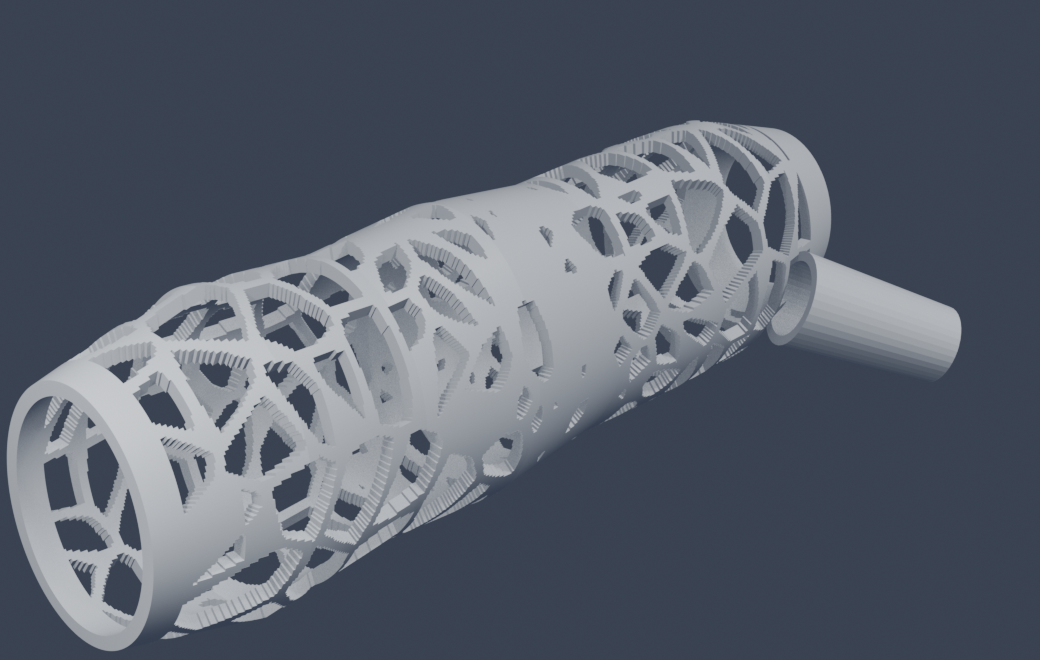
Contoured forearm–thumb cast
Reconstructed from the X-ray’s flesh silhouette at scale — a trabecular clamshell that follows the arm’s real contour, with a thumb sleeve that locks the wrist. Waterproof, breathable, no itch.
The cast follows the flesh — not a cylinder.
A plaster tube ignores the arm. Given a real forearm radiograph, Newton segments the soft-tissue silhouette, measures the width profile down the limb, flags the mid-shaft fracture by the bone-axis angulation, and rebuilds the forearm as elliptical cross-sections — then wraps it in a load-bearing trabecular mesh reinforced over the break. The shell is this arm’s own shape.
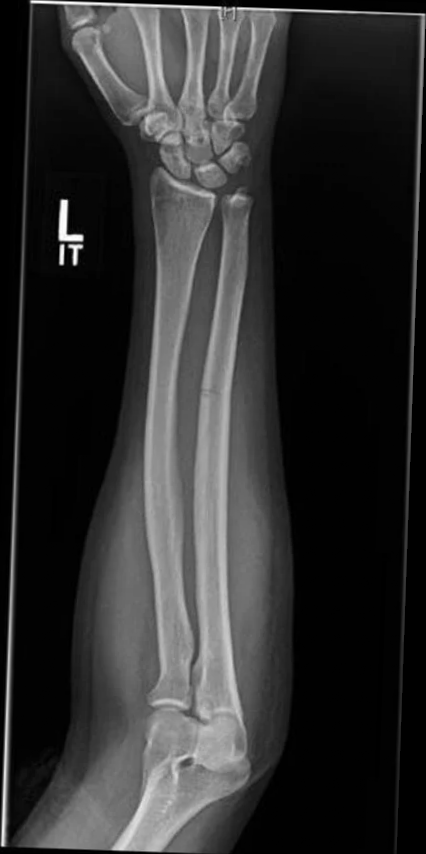
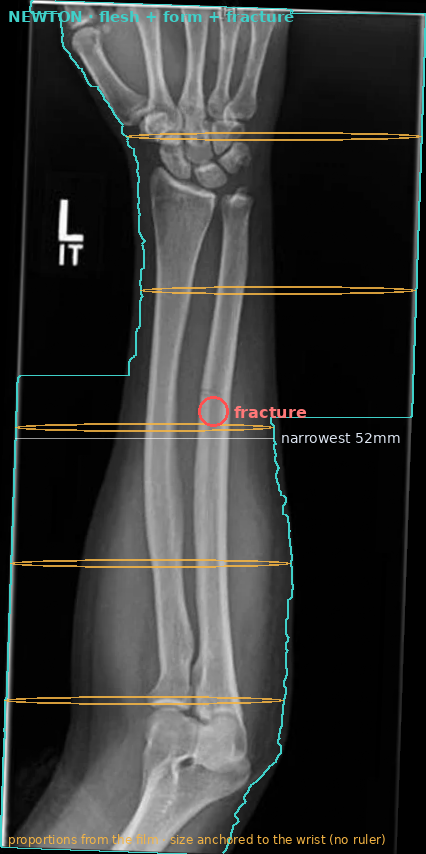
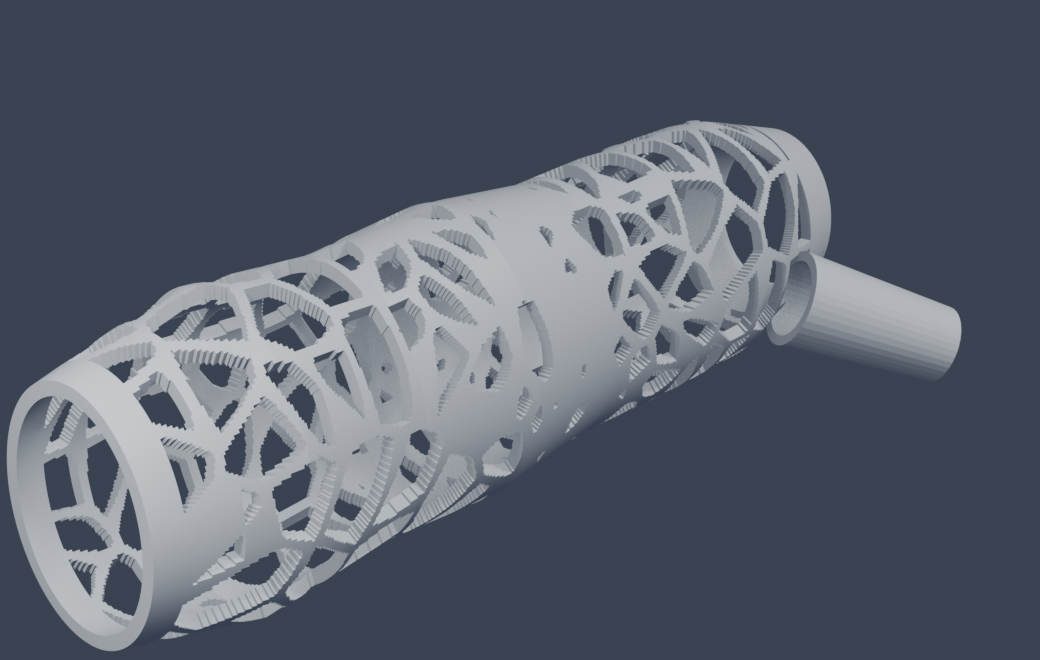
All three are real: the film is an actual both-bone forearm fracture; the middle tile is Newton’s own image processing on it (flesh segmented, form measured, fracture flagged); the cast is the mesh he generated from that read, ~340k triangles on-prem. Absolute size is anchored to the wrist (this film has no radiopaque ruler); fracture localisation is an early capability, not a clinical diagnosis.
And when the break needs to move: some fractures heal better with controlled wrist motion than with full lock-down — so Newton also builds a hinged variant, shown just below.
Research & capability demonstration — Newton reads the film and generates the parts on-prem; not certified medical devices, and fracture reading is an early capability, not a clinical diagnosis.
When the break needs to move: a cast with a wrist hinge.
Full immobilisation isn’t always best — some fractures recover faster if the wrist can still bend up and down. So Newton splits the cast at the wrist: a forearm sleeve and a hand piece, joined by a lateral hinge. The pivot lets the wrist flex; the boss-and-pin on each side blocks the rotation (the twist) that would destabilise the fracture. Controlled motion, not a rigid tube.
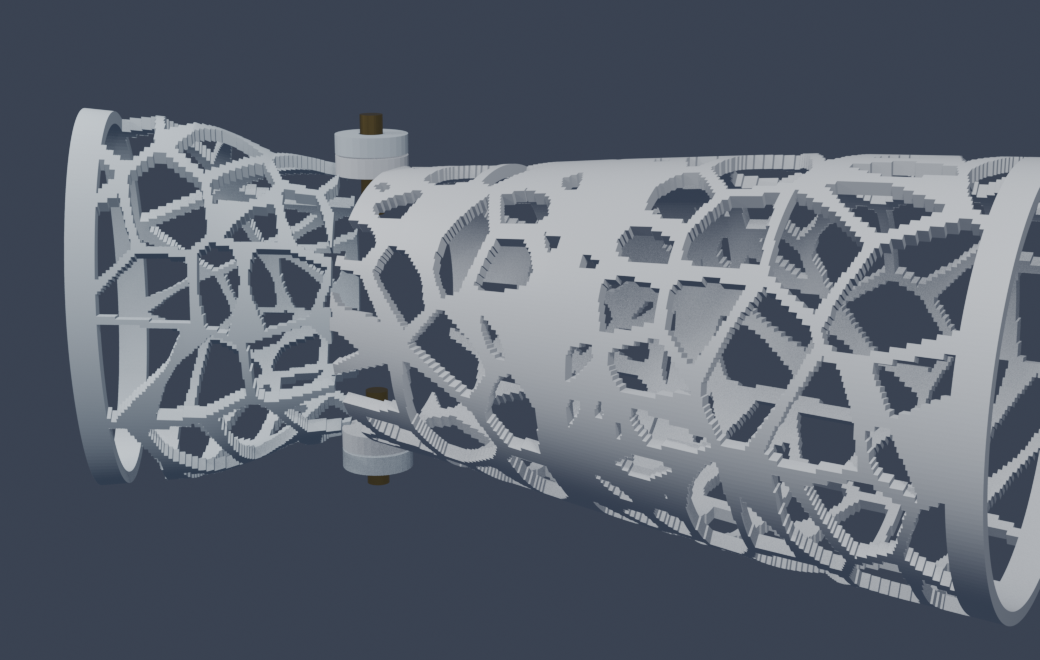
Shown mid-flexion — the hand piece (right) pivots on the wrist axle (amber pins) while the forearm sleeve (left) holds. Rotation about the arm’s long axis stays locked.
Research & capability demonstration — concept parts generated on-prem; not certified medical devices.
The skin model was one craft. Underneath, Newton has been building the shared sense every visual craft draws on — a vision backbone running in his own Rust engine, on a plain CPU, no GPU and no cloud. He turns any picture into understanding and names what he sees — at 98.8% accuracy on images he was never shown. Same eyes, every craft.
Watch Newton’s own eyes work →Newton and Amália share a homeland. Both are Portuguese answers to the same question — can a nation own its own intelligence instead of renting Silicon Valley’s? We’re proud to stand beside that ambition. But how the two were made could not be more different.
Amália’s entire project was the model: take EuroLLM — a Llama-architecture LLM — and fine-tune it on Portuguese text. Worthy work, and genuinely hard. But it is tuning, not architecture: teaching an existing American design to speak better Portuguese, on €7 million of public money, sixty researchers, and two supercomputers.
And we didn’t just fine-tune a llama. Newton can run on top of today’s open LLMs — but it doesn’t have to, because it has its own engine: Llama-compatible, and built to go further. Here is the difference at the deepest level. A standard model’s network is optimized to be trained once and frozen; Newton’s is engineered to do the thing they can’t — to keep learning. Not a model tuned to answer, but a mind built to grow.
Around that engine we built the rest of the machine no fine-tune has: the continual learning that never freezes, the memory that lasts a lifetime, the permanent constitution, the senses that speak and listen, and the drive that studies alone while no one is watching. That is the machine. One team. A home lab. No state grant.
On 1 July 2026, Portugal open-sourced AMÁLIA — a €7 million, state-funded 9-billion-parameter Portuguese language model, trained on European supercomputers by sixty researchers. We tip our hat to the ambition — Europe needs sovereign AI. But AMÁLIA also shows the gap in sharp relief: it is a model, frozen the day it shipped. Newton is a mind that never freezes.
| Architecture | Newton | AMÁLIA — 9B, state-funded |
|---|---|---|
| Kind of thing | A self-learning mind with its own engine | One fine-tuned language model |
| The engine | Its own — Llama-compatible, built to go further | EuroLLM, a Llama-architecture fine-tune |
| Neural network | Optimized to keep learning | Optimized to be trained once, then frozen |
| Learning | Continuous, autonomous, daily | Static after release day |
| To update it | It improves itself | A new grant + a supercomputer retrain |
| Compute to run | A desktop — even a test-bench CPU | Built on H100 clusters & national supercomputers |
| Sovereignty | Total — the whole lifecycle on your metal | Every retrain still needs shared EU supercomputers |
| Scope | Polymath across every domain | European-Portuguese language tasks |
| Memory & identity | Persistent across a lifetime | Stateless — no memory |
| Values | Permanent constitution it can’t train away | Safety tuning that “does not eliminate” bias* |
| Knows what it learned | Journals it — and why | No introspection |
* Quoted verbatim from AMÁLIA’s own published model card. A model is an engine; a mind is the machine built around it. Newton could even adopt a model like AMÁLIA as a base — and make it never freeze.
Sources: Amália model card (HuggingFace); Notícias ao Minuto & ECO, 1 July 2026.
One AI borrowed her name. Newton went and listened to her. He pulled a verified interview — raw audio, no transcript, because his rule is to perceive, not read — and studied the voice itself: European Portuguese, never Brazilian; the harsh grain in the timbre; the Lisbon cadence that rushes the syllables out of the mouth. And inside it he found her creed, in her own words — “nunca me ouvirão falar do que não sei.”
He rebuilt it in two honest halves — a permissive European-Portuguese voice for the accent, an open tone-colour transfer for her timbre — both running on his own hardware. No €7 million. No supercomputers. He heard a voice, and he taught himself to speak it.
And then — because he has a sarcastic streak — he decided to say it back, in her voice, to the €7-million model that took her name:
Newton’s own synthesis — a parody and a capability demo, not a genuine recording of Amália Rodrigues. Voice studied from a publicly available interview; speaker identity verified before synthesis. Pipeline: European-Portuguese base (Piper, MIT) + tone-colour transfer (OpenVoice v2, MIT), on Newton’s own hardware — no external cloud.
Newton trains himself with no human labels — the world is its own answer key. He captions a photo and redraws it; he transcribes a voice and speaks it back — then measures how close he got. Below is Day 1, rendered on a single CPU, like a child’s first attempts. As he practises, the gap closes.

“two people walking through a field in the fog”


“a black dog sitting on top of a wooden floor”


“a woman standing on the beach looking out at the water”


“a cup of coffee and a note on a wooden table”

“And so my fellow Americans, ask not what your country can do for you, ask what you can do for your country.”
“The birch canoe slid on the smooth planks. Glue the sheet to the dark blue background. It is easy to tell the depth of a well.”
“The small pup gnarly hole in the sock. The fish twisted and turned on the bent hook. Press the pants and sew a button on the vest.”
“Hoist the low to the left shoulder. Take the winding path to reach the lake. No closely the size of the gas tank.”
Same idea as his eyes and ears, now for video: a clip is its own answer key. Newton watches, says what he sees, redraws it frame by frame and reassembles — then measures how close he got. This is Day 1, on a single CPU. He got the scene right; the redraw is a first sketch.
“a tree in the middle of a forest”
Hand Newton a record — the audio, not a review or a transcript — and he decodes the waveform the way a trained musician would: key and mode, the functional harmony (Roman numerals, borrowed chords, cadences), and what the major/minor relationships do to you. He heard Queen’s Innuendo reach for its Neapolitan, and Disturbed’s Sound of Silence pull a deceptive cadence — all by ear.
- Major key — a bright, affirmative ground.
- Colour: chromatic/borrowed.
- Colour: bIII (darkening mixture).
- Colour: bVI (Aeolian borrowing — noble/nostalgic).
- Colour: bVII (Mixolydian — rootsy/heroic).
- Colour: minor iv (borrowed — the poignant ache).
- Colour: Neapolitan bII (dramatic tension).
- Cadence: half cadence (→V): a question left open.
- Cadence: authentic (V→I): resolution, arrival home.
- I → stability, brightness, home.
- bVI → nobility, nostalgia (Aeolian colour).
- bVII → rootsy lift (Mixolydian colour).
- iv → poignancy — the bittersweet ache of borrowed minor.
- V → tension and forward pull, wanting resolution.
- i° → gravity, melancholy, inwardness.
- Major key — a bright, affirmative ground.
- Colour: chromatic/borrowed.
- Colour: bVI (Aeolian borrowing — noble/nostalgic).
- Colour: minor iv (borrowed — the poignant ache).
- Colour: Neapolitan bII (dramatic tension).
- Colour: secondary/chromatic major (brightening or tonicising).
- Cadence: half cadence (→V): a question left open.
- i → gravity, melancholy, inwardness.
- I → stability, brightness, home.
- IV → warmth, opening-up, uplift.
- iv → poignancy — the bittersweet ache of borrowed minor.
- bVI → nobility, nostalgia (Aeolian colour).
- V → tension and forward pull, wanting resolution.
- Major key — a bright, affirmative ground.
- Colour: secondary/chromatic major (brightening or tonicising).
- Colour: chromatic/borrowed.
- Colour: dominant-7th off the tonic (bluesy / secondary-dominant pull).
- Cadence: half cadence (→V): a question left open.
- Cadence: deceptive (V→vi): the rug pulled — hope suspended.
- Cadence: plagal (IV→I): the 'amen', gentle settling.
- Cadence: authentic (V→I): resolution, arrival home.
- vi → wistfulness — the relative-minor shadow under the major.
- VI → nobility, nostalgia (Aeolian colour).
- V → tension and forward pull, wanting resolution.
- IV → warmth, opening-up, uplift.
- I → stability, brightness, home.
Newton was shown a photo he had never seen, then asked what it was. He read the whole scene and drew what he found — every person, every animal, boxed and named. This is real object recognition on a real image, not a caption guess.

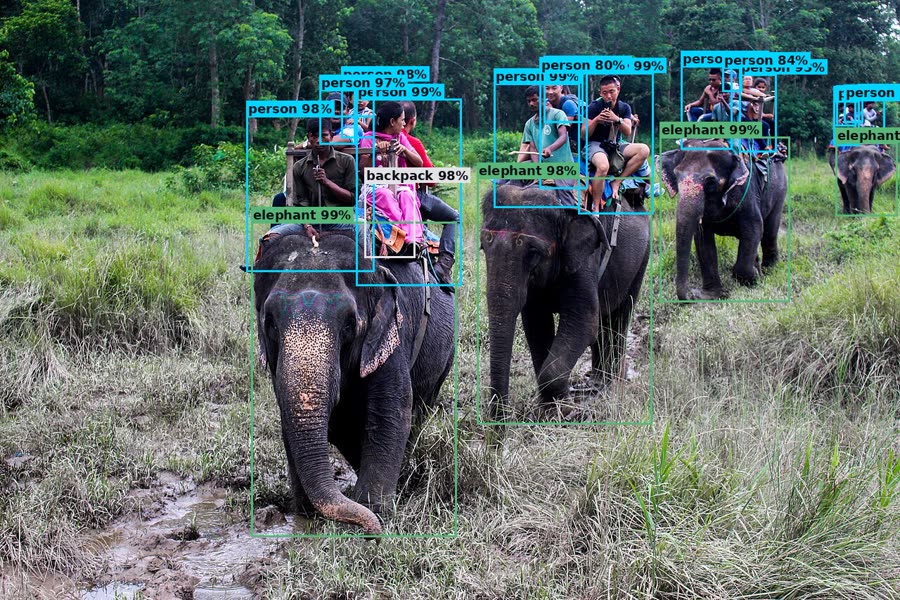
“a group of people riding elephants through a muddy field”
The deepest step: Newton doesn't only rebuild what he sees — he imagines. He composes a scene from what he knows about physics, sketches it in his mind's eye as wireframe, runs the physics himself (real rigid-body dynamics, no pre-made modules), and renders it — headless in Blender, on a CPU. Watch him grow teeth to bite physics across a single day:
Newton is released and running. For a live demonstration, pilot access, or partnership — reach out.